

SAILING THE IONIAN SEA
We returned to Greece the first week of September 2023. As we were driving south, we had with us the last “wave” of European holidaymakers that were also heading to the Mediterranean. That made us wonder if we took the right decision to return to Greece so early in autumn. But we had a good reason for doing so: we wanted to prepare “Samourai” for our passage to Italy. After 3 days travelling, we finally arrived in Corfu exhausted but so happy. We immediately drove to the marina to check the boat. Samourai was there, floating on her mooring and faithfully awaiting our return. At the same time we noticed that Gouvia marina was still very busy with charter boats coming and going.
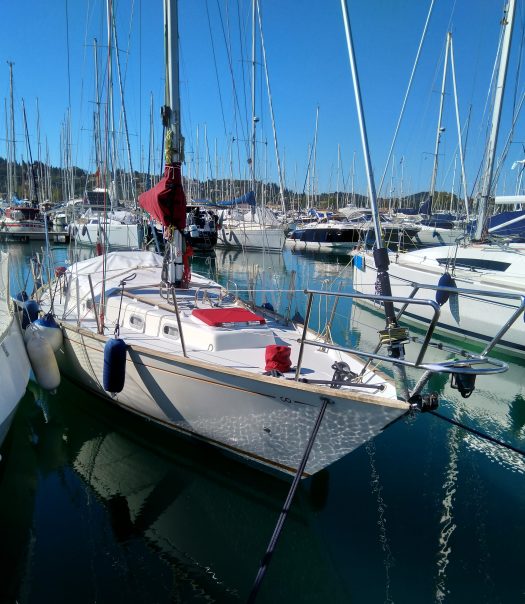
In the days that followed, we began actively to prepare the boat for sailing. As usual, an exhaustive list of jobs had to be done: washing the deck, applying teak wonder on the toe rail, replacing the kedge anchor with a new Fortress anchor, reducing the stern scope of chain, hoist the sails, prepare the reefing lines…etc. And last but not least: install a radar reflector on the mast, above the spreaders. That was a bit demanding for both of us. But with perfect coordination and team work, everything went well. After nearly two hours hanging in the air, we had our new radar reflector attached to the mast.
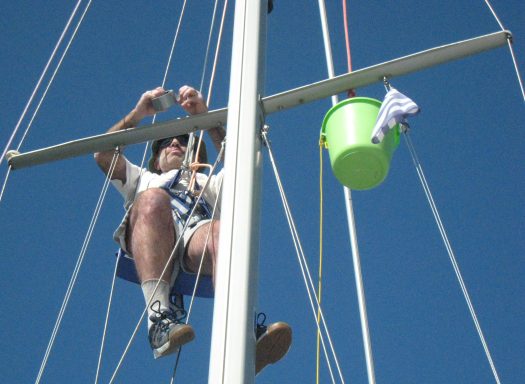
All scheduled jobs were quickly done and, after a week, we finally moved on board. It was now time to go out for a sea trial.
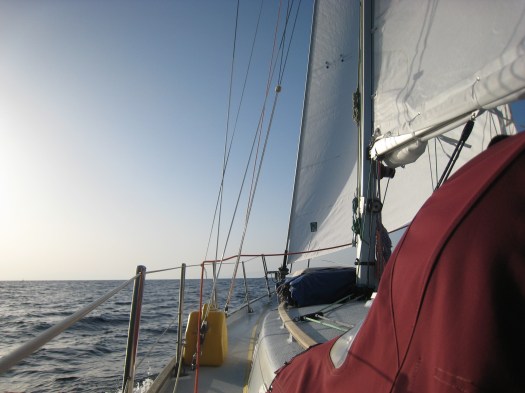
On a nice afternoon in the middle of September, we followed the path out of the marina channel and put the course towards Garitsa Bay. The main harbor was full of cruise ships and the bay south of the Old Fortress was packed with super yachts at anchor.

We continued motoring in the direction of Mon Repos and finally dropped the hook just outside the Queen’s Pont. But before we even had the time to enjoy the scene, a “plastic fantastic” 3 floors super yacht arrived, dropped his anchor a few yards away and the party began. The stern opened up and all type of toys came out: jet skis, water slides, plastic dragons, inflatable ducks … and many other things for the clients on board to play with. And they did play, screaming like there was no one else around. Those are the joys of summer in the Ionian !
We went silently in the water trying to ignore as best as we could this turbulent atmosphere and managed to clean the hull under the waterline including the propeller and the anode. Soon afterwards, we lifted our anchor and headed back to the marina. We had enough for the day.
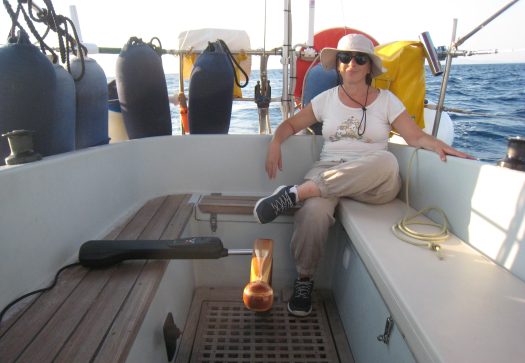
The next morning we were out again to calibrate the autopilot. After an hour messing around in circles we finally managed to set the tiller pilot. For the first time, in all those years of owning Samourai, we discovered the joys of having an autopilot steering the boat. Our new Simrad autopilot was a revelation ! We had now an extra pair of hands enabling us to do any other maneuvers on deck or simply sit and enjoy the journey. What a luxury !
It was past midday and we continued our course to the north. We were heading between Corfu and Albania, towards a little Island called « Kapareli » which is located in the middle of the strait. On the top of it, a lighthouse overlooks a rocky promontory. Entering those waters, a little breeze from the north began to blow. We turned off the engine and enjoyed some nice close hauled sailing. As a foresail, we had the light genoa hoisted and the boat was going pretty well until we approached Kapareli. At first, the plan was to tack around the rocky lighthouse. But as we progressed, the wind picked up and eventually reached over 20 knots. We could not remain so close to the wind with this light sail on, so we finally bore away and changed course to the south. As it is often happening in Greece, the wind dropped a few miles later to a complete no wind, only to blow again outside the marina entrance.
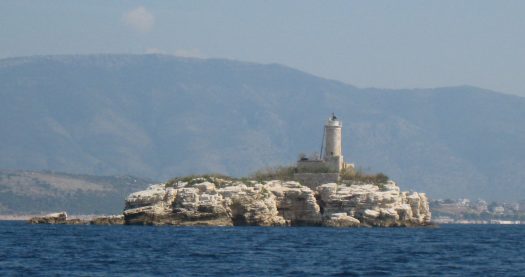
On the way back, we had a little chat about our future plans to sail to Italy. Since we were not very trained after being so long off the boat, a feeling of uncertainty was hovering among the crew. We were not feeling ready to cross the Adriatic Sea. First of all, we had to get back our sea legs gently. On the other hand, we thought Italian ports would still be very crowded at this time of the year. For those reasons, we decided to postpone our plans and instead, go sailing around the Ionian Islands to get a few more miles done in familiar waters.
Our first trip with ‘Samourai’ took us southwards to the port of Plataria. On the way, there was no wind at all with very calm weather conditions. To our surprise, that day, there weren’t many charter boats sailing around. They say that having a sailing boat is 80% hard work and 20% pleasure. Well ! That day we had a pay off of this famous 20%. “Captain Jim, ” our auto pilot, was steering the boat and we could sit on deck and appreciate a zen situation !
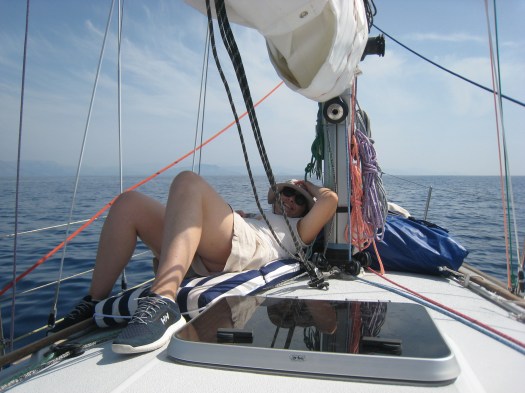
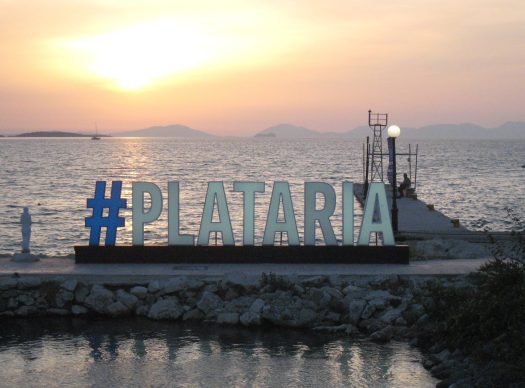
We arrived in Plataria and discovered that the port had now lazy lines so we didn’t have to drop the anchor. We paid 10 euros for the night, plus some extra 5 euros for water and electricity. After having a cold shower in the cockpit we headed towards the village to get something to eat. The next day we returned to Corfu under torrid conditions that unfortunately did not allowed much sailing. But our first night out was accomplished and we knew that everything was working fine on board, including all the navigation lights.
At last, by the end of September we were ready for our trip to the Diapontian Islands located in the northwest of Corfu.
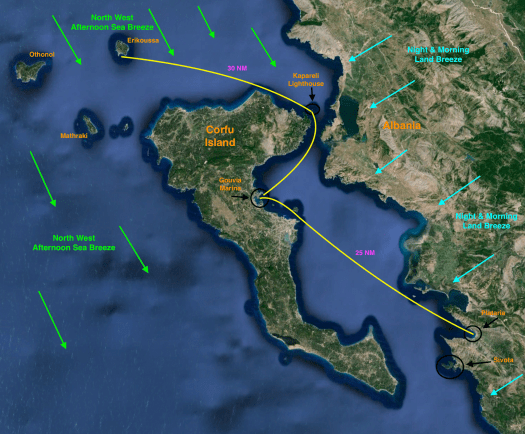
Our confidence gradually increased and we could now think of a longer journey. We chose to visit a small Island called Erikoussa situated about 30 NM north of Gouvia marina. The island has now a new marina and a wide anchorage in a sandy bay. In other words, a little paradise out of the beaten tracks.
We casted off at 4 o’clock in the morning. An impressive full moon was setting on our stern and made everything as bright as day. As we were going out of Gouvia bay we experienced a magnificent clear sky, full of stars that shined like diamonds. Orion was on starboard, Sirius and Jupiter above us and far away over the mountains, Venus was just ascending. Noticing a light breeze coming from the mainland, we hoisted the main and unrolled the Genoa. Dawn found us as we were passing the reef “Serpa” on our port side. We passed Kassiopi just as the sun was rising. But behind us, a “left over” wave disturbance was rolling the boat making the passage slightly uncomfortable. It was due to a mountain breeze which was blowing the previous night. The motion of the boat wasn’t very pleasant, nothing too serious though.
We entered Erikousa marina before the Northwest (Maistros) wind began to blow, secured our lines and slept for a few hours.

In the afternoon we went for a swim in the nearby beach, just outside the port. It was nearly empty at this time of the year with a few locals having a sun bath. At anchor we counted only 6 boats, possibly because of the price of the marina : for 3 nights we paid 80 euros ! That was the end of the season and the island was almost empty. Most of the shops and restaurants were closed. The only place to get something to eat was the restaurant of Leonidas that along with the mini market next door, is the only place that stays open during winter. We ate there all the days that we stayed on the island.

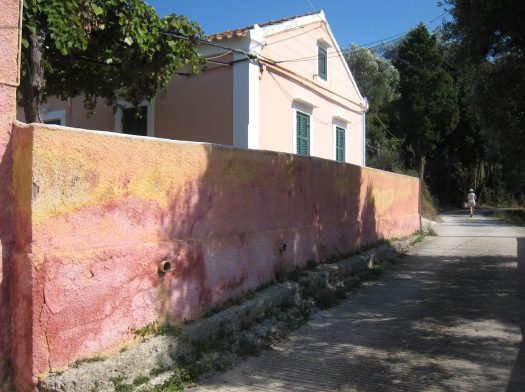
The day after our arrival we went for a walk around the island and enjoyed the stillness and the beauty of the place. Erikoussa is so close to Corfu and part of it, but still so different.
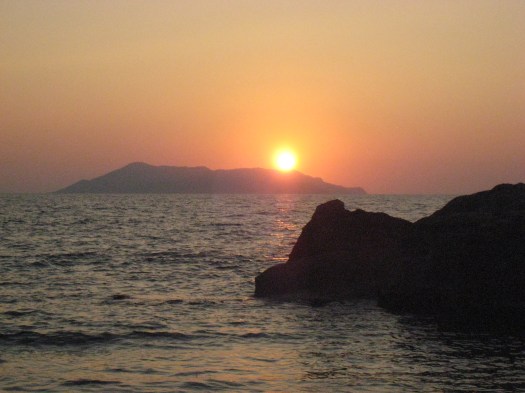
The evening before our departure, we experienced a magnificent sunset over Othonoi.
We stayed there for 5 days and on the sixth day we returned to our island. While sailing back to Corfu we had a little briefing about our future plans. It was by then almost mid October and after many conversations, discussions and thoughts, we resolved not to go to Italy at this time of the year. Firstly, we needed more time practicing and living aboard. Secondly, the days were getting shorter and the weather didn’t give us any window for a smooth passage. The plan was now confirmed, we would head south and find a quiet spot to spend the rest of the autumn.
After these few days in Erikoussa we were now feeling more confident to continue our trip towards the Ionian Islands. We came back to Corfu for a quick stop and left after two nights. It was Saturday, a very busy day because of the change over for the charter companies. We left in a hurry, slightly after midday. The wind was perfect, blowing from behind and we only had to cover about 22 NM to reach our first stop: the little port of Plataria.

We dared to make a night landing because we already knew the port. A few days were spent relaxing in Plataria which was much quitter than Corfu. A charter company is also based there but the place is friendly and there are nice tavernas serving fresh fish. In the evenings, some fishing trawlers come and unload their catch on the quay.

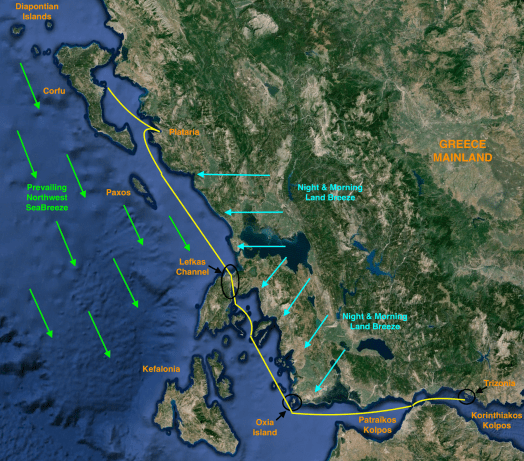
Few days later, again around 4 o’clock in the morning, we left for Lefkas. Coming out of Plataria we preventively put a reef in the main. As it was pitch dark, it took us a bit more time to accomplish the maneuver. But, with the help of the autopilot, everything went well. We do often sail with a reef in the main, even on calm days. It may be an excess of prudence, but we’ve learned by experience that in Greece you can frequently be surprised by strong katabatic winds out of nowhere.

After the sun came up, a nice easterly breeze gave us 15 to 18 knots of apparent wind. We cut the engine off and had a proper sail for a while. With a reef in the main and the yankee all out, Samourai was beating at a nice speed of 5.5 to 6 knots. This is to say that it is not always necessary to have all the sails out in order to reach a good speed.
Approaching Lefkas channel, we realised that we were going to miss the 14h00 bridge and had to reduce speed to get in an hour later. The problem was that other boats were heading exactly in the same direction. Waiting for the Santa Maura bridge to open can sometimes be a little tricky. As a matter of fact, there is often current in the waiting area and in addition, there is little space to maneuver. We had to ferry glide for more than 30 minutes behind the breakwater. Then the floating bridge opened and all the boats raced through the canal. This can sometimes become a hazardous situation due to the fact that when the bridge opens, no one respects the raw and all boats rush together to cross. Thankfully, we entered Lefkas marina without any trouble.
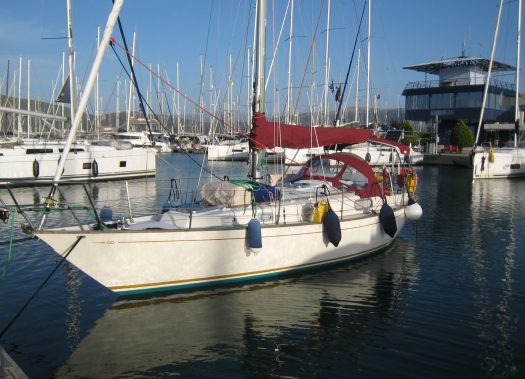
We stayed there for two nights waiting for the next suitable weather window. On the third day, we went back into the channel and continued our way south. To our great surprise, when we came out on the southern side of the channel, we discovered that there were still many boats sailing around. Good for them, bad for us. We had to decide quickly where to go if we wanted to avoid the crowds. It was obvious at this point that whatever port we were choosing on the islands it was going to be packed with charter boats. However, the good news was that it was the end of the week and most of them were heading back to Lefkas. Taking that into account, we decided to go for the mainland and entered into Astakos for the night. This small fishing port has a few tavernas and is rarely over crowded at this time of the year.
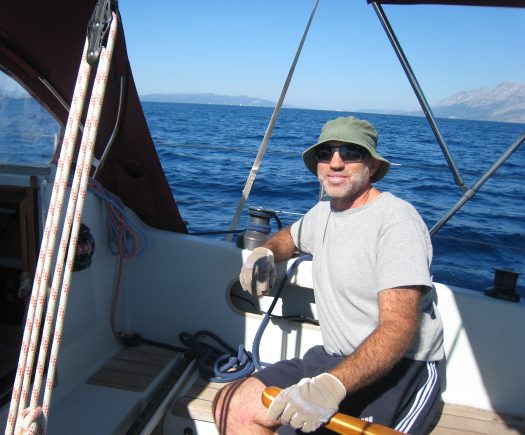
On that evening, we sailed into the bay of Astakos while some impressive gusts were blowing down the mountain Veloutsa. As if by magic, when we entered the port, the wind completely vanished. Apparently, there is a relatively good protection from the Northwest wind and once inside the port, you are well sheltered. We dropped our new Fortress kedge anchor for the first time inside this muddy bottom with the risk of catching something. Very quickly after the anchor touched the seabed, the boat stopped abruptly and we thought that we caught a chain or something else. We were almost sure that next morning the captain was going to enjoy an early swim. Not too great of an option when we realised that next to the boat, there were huge sewage pipes emptying their guts in the sea water. That would add a touch of perfection to the morning bath.
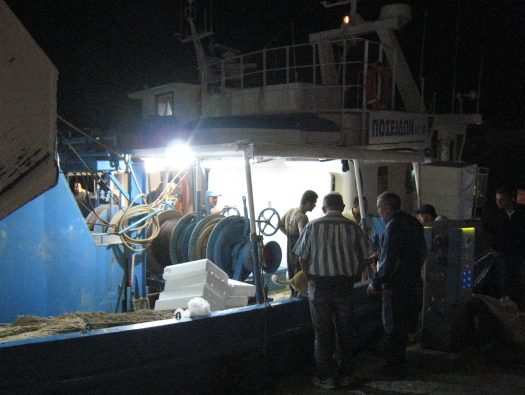
The charm of this port also lies in the fact that it is a fishermen stopover. While we were enjoying our dinner peacefully on the water front, we witnessed the arrival of 6 fishing boats almost simultaneously. All of a sudden, the village seemed to be waking up. Refrigerator trucks and vans appeared on the dock in order to collect the catch. And last but not least, the ferry that connects Ithaka and Kefalonia to the main land, arrived. In the middle of the evening, the quiet fishing village of Astakos, became a busy haven.
Next morning we woke up early with only one thought: how easy it was going to be to unstuck our precious new aluminum anchor from the seabed of this dirty port…But as soon as we started hoisting the chain, we actually realised that the anchor did a perfect job. It dug through the mud so well that the boat was instantly immobilized. After bringing the anchor up so easily, we returned to our normal routine and motored out of the bay. For now, we were very impressed by the holding power of the Fortress anchor.
At 10:18 am we rounded the island of Oxia and entered Patraïkos Kolpos under perfect conditions. Oxia belongs to the Echinades Archipelagos and is the most southern of those islands. With its’ light house, it marks the turning point where all ships change course when entering or leaving the Gulf of Patras.

Just as we were eating our breakfast, we had the visit from a lonely dolphin which came to say hello. Half an hour later, we saw a sword fish jumping around like crazy and we also thought we spotted a small shark later in the day. A busy sea indeed.

As we were approaching the Rio – Antirio bridge the current increased. Fortunately, it was from behind and pushing us towards the “right” direction. We began noticing an increase in the SOG (speed over the ground) making 6 knots just with our engine and the Genoa. 5 NM before the bridge we called Rio Traffic on channel 14 for identification. A very polite gentleman gave us the instructions on where to cross and asked us to call again 1NM before the bridge, for the final confirmation. That’s the normal procedure for this bridge because there is quite a bit of traffic with ferries crossing non stop from one side to the other.

Once under the bridge, there is always a lot of current. In practice, for a small vessel it is almost impossible to cross with adverse conditions. But that day Patraikos ‘kicked’ us smoothly inside Korintiakos Kolpos with an impressing 7.4 Knots over the ground !
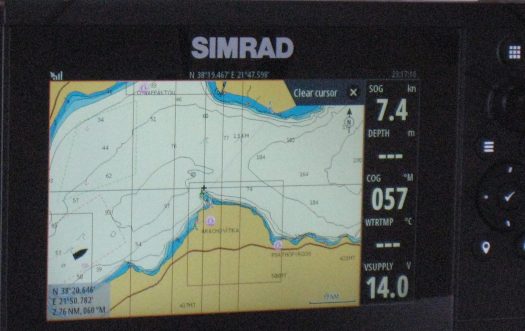
In fact, the current gave us a very good push that helped us gain almost an hour on our ETA (Estimate time of arrival), resulting our arrival at the island of Trizonia when the sun was setting.
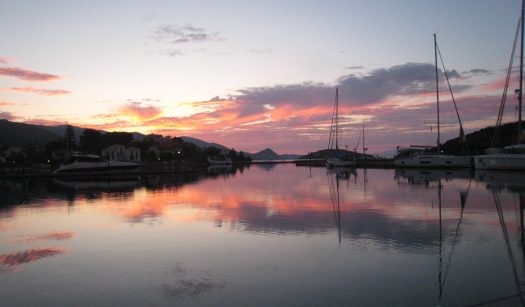
After 60NM and 12 hours motor sailing, we tightened our lines just as twilight was giving place to darkness. From Corfu to Trizonia we had covered over 150 Nautical Miles with mostly calm seas and fair winds.
 SAILING "SAMOURAI"