

SAILING BACK TO CORFU
To exit the Gulf of Corinth, we had to pass again under the bridge of Rio-Antirio: a short distance of 15 NM. After that, 30 more miles were left to reach Oxia and finally the Ionian Sea. In between, there was only one possible stop: Missolonghi. A port situated in the middle of a marshland and accessible via a long narrow channel dug through the sandbanks. We both agreed that it was better to avoid this place and taking into account the short weather window, our first plan was to reach Lefkas in one leg. But the morning we left Trizonia, the weather was looking fine for at least a couple of days.

We had an amazing trip until the bridge. The mainsail was up, with the usual first reef in and, for a short time, we also had the genoa out. Until Rio-Antirio, the wind was more or less in our favor. At exactly 12:10, we passed under the hanging bridge and entered the Gulf of Patras on a flat sea. Unfortunately, these conditions didn’t last long. Soon after, the wind direction changed and it started blowing against us.

A few miles further west, we had our first glimpse of the strong northerlies that were blowing out in the Ionian Sea. Thankfully, in front of Patras, the wind was only reaching a force 4, but it was blowing from the west. That slowed us down and dropped our speed 1 to 2 knots. It was by then almost 14h00 and we knew that reaching Lefkas that day was out of the question. Still, we were worried on how easy it was going to be to enter the Missolonghi channel with an onshore wind. It is important to note that the depths around the entrance are quite shallow and that the area is full of sand banks. The pilot book was clear on that: avoid any approach with strong westerlies or south westerlies. Thankfully, the more we advanced towards the entrance, the more the sea was calming down.

We entered Missolonghi Marina just as the sun was falling. Once the berthing maneuvers were accomplished, we went straight to the showers and enjoyed the hot water. It was a luxury that we didn’t have for the past 2 months. We were exhausted but also very hungry. A 20 minutes walk through the dark empty streets took us to the town. There, we found a restaurant where they served excellent grilled fishes. After few beers and a very descent meal, we walked back to the marina. That night, the surrounding swamps sent us a chilled land breeze and made us realize that winter was approaching.

The next morning, we woke up at 5 o’clock and casted off with the first sunlight on the horizon. Again, the air was fresh and the atmosphere very clear, with just the usual morning breeze coming from the mainland. That was exactly what we needed: a wind coming down the mountains and from the northeast quadrant. We hoisted the main sail and unrolled the genoa. At first, we were pushed towards Kefalonia, but gradually, as we advanced to the west, we could point a bit higher and corrected our course towards Oxia. As we approached the headland, the wind died down and we experienced a funny coincidence when, at 10:18 am, we rounded the south tip of the island. At the moment of writing the entry into the log book, we realized that we were passing the cape at the exact same time we had passed it a month before. Perfect timing or, simply, perfect planning !

Once Oxia was left on our starboard, the easterly wind came back and for a little while, we could use the extra speed the genoa gave us. As expected, by midday, the wind dropped completely and we kept motoring with the main up. By then, it was time to lift the spirits. We prepared a nice coffee and had a few cakes and cookies as a treat. As we were sipping our espresso’s, we enjoyed a nice sunny afternoon of total calmness in the archipelago of Echinades.

Few hours later, while approaching Meganisi from the south, a strong afternoon breeze started blowing from the northwest. It was the usual “Maïstros” which quickly reached force 5 and was gusting against us.

Thankfully, as we were advancing towards Lefkas, the wind died down completely. The sun was slowly disappearing behind the mountains and, as we were entering the narrow Lefkas channel, we experienced one of the most amazing twilight scenery.
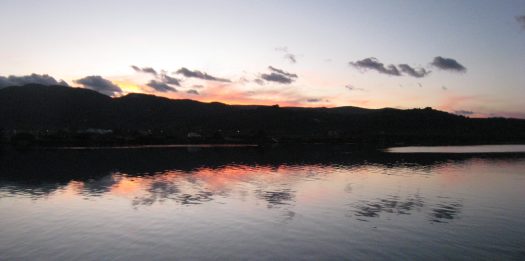
Like the previous evening, we managed to berth “Samourai” just as the night was falling. Indeed, that perfect timing was due to a good passage planning. That evening, we went out into Lefkas town and celebrated our successful trip with a well deserved meal and a few pints.
The following morning, we woke up with painful bodies, but there were still a few jobs to be done. We unrolled the genoa, rinsed it thoroughly and gave a good scrub to the deck. Then the fuel tank was topped up and the interior of the boat cleaned with the vacuum. After that cleaning session, we were finally able to relax and wait for our next weather window. The last leg of our trip would take us back to our island.
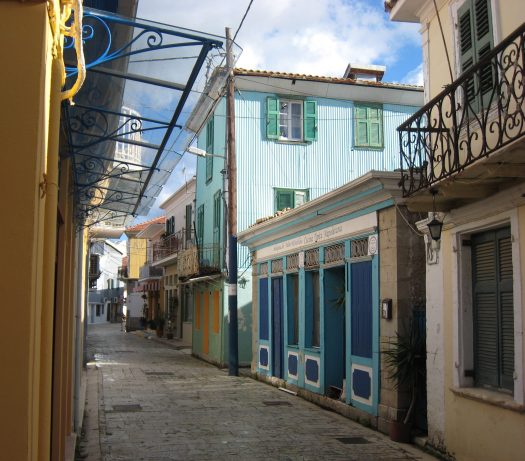
During our stay at Lefkas Marina, we experienced a serious storm. The forecast was predicting a lot of rain but also very strong winds coming from the northwest. This wind direction was very unusual for that time of the year and the strength of the wind was also quite worrying. In summer, a northwesterly breeze is typical of the Ionian Sea. But, at this time of the year, a depression bringing such a strong blow was exceptional. First, we had to endure the warm front which brought southwesterlies with lots of clouds and rain. And after that, the wind veered to the northwest and reached up to force 9. Strangely, even when the barometer started to climb up, the rain didn’t stop ! The local weather station, which was just above the marina office, recorded gusts up to 50 knots !
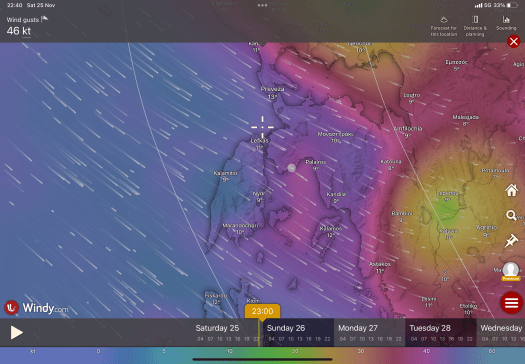
In anticipation, we had removed everything from deck: genoa, spray hood and bimini were all folded and stored away. No need to say that we didn’t sleep for the whole night due to the howling of the wind and the rocking of the boat. It was certainly a very difficult night altogether but thankfully, we had no unpleasant surprises.
A week after that storm, there was still no suitable weather window. Since winter had arrived and the low fronts were passing one after the other, we decided to rent a car and explore the region.
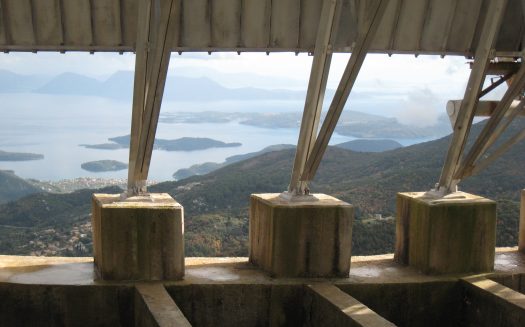
Following the directions of some locals, we drove up to the summit of Lefkas and discovered an abandoned NATO radar base.

An impressing site with a splendid view. Regrettably, the amount of steel and concrete left there to rot was a sad image.
On a cloudy afternoon, we visited the beach of Agios Nikitas and enjoyed this marvelous place finally deserted by the crowds.

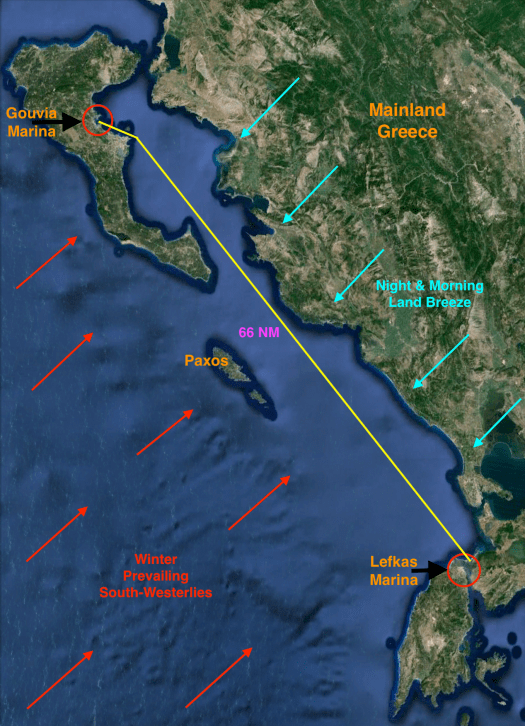
One early morning, in the beginning of December, we woke up with a really good weather. That day, the forecast was predicting strong northerlies in the Ionian Sea and, for the next days, another depression. At last, the wind was fine and the sky all clear. Again, the decision to leave was taken at the last minute. After quickly preparing everything on deck, we casted off at 10:53, seven minutes before the opening of the Lefkas bridge. We didn’t even knew for sure if we were going to make it ! We called the bridge on the VHF and surprisingly, the man in charge waited for us a few more minutes and opened at 11:05 ! Thankfully, there were no other boats waiting to pass, so we went out with no problem at all. But as we were leaving behind us the breakwater, we had a first glimpse of how our journey was going to be. Due to the northerlies, a big swell was coming from the open sea. However, the barometer was high and the visibility excellent. A few hours later, at a distance, we could already glimpse Corfu on the horizon.
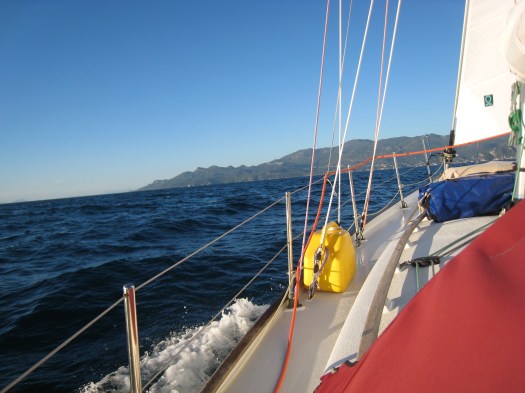
At some point, the rolling of the swell was impressive. Just as the night was setting, we passed Paxos on the Portside. And when the night finally settled, it brought again cold air from the north. The sea state didn’t improve much but we were hoping that after rounding the south tip of Corfu, the swell would stop.
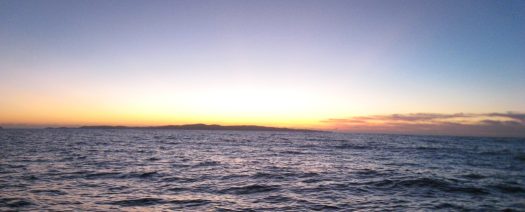
The waves did diminished, but after a few more miles, just outside Lefkimi, a cold northwesterly wind blew again, reaching force 4 to 5. We had to endure an annoying chop for the next 3 hours: again, the elements were slowing us down. Gradually, we were getting tired and the cold started to become almost unbearable. At a far distance, we could distinguish the flashes of the lighthouse of Corfu’s Old Fortress. Meanwhile, the city lights were sluggishly getting closer. Around midnight, we rounded the old Fortress and eventually found calmer waters. At last, we were advancing on a quiet “lake”. The night was getting very chilly and the last 3 miles towards the marina were like ghosting in front of a deserted town. As we were getting closer to the entrance, we noticed that the channel was not very conspicuous. It seemed that the red light of the first marking buoy was broken. A small difficulty which obliged us to keep a good look out.
At 01:00 am, on the 5th of December 2023, “Samourai” had returned to its homeport, after 75 days living aboard !
 SAILING "SAMOURAI"